
Hypophosphites in Industrial Applications: A Practical Guide

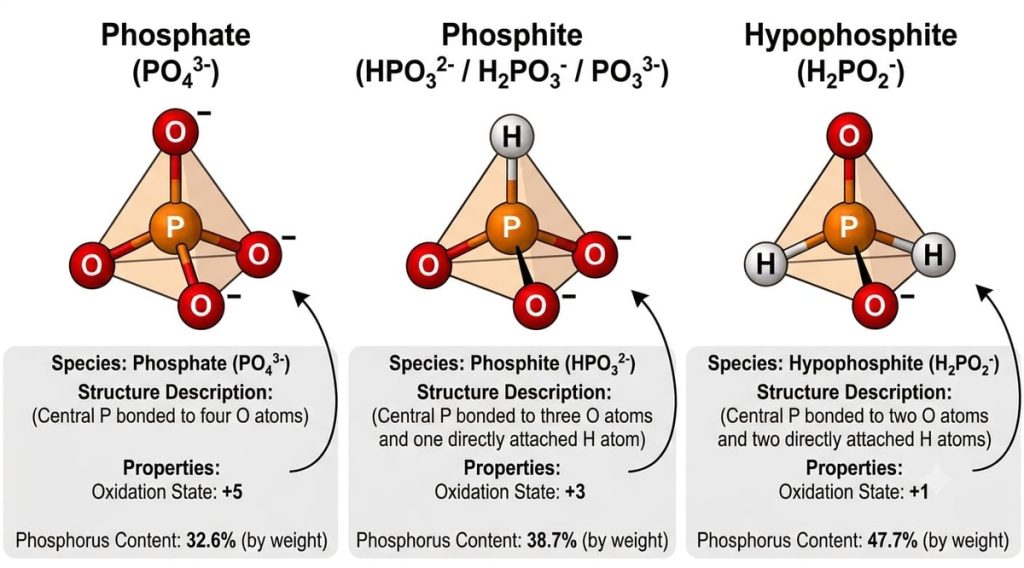
Hypophosphites are the salts of hypophosphorous acid. Three structural features set them apart from every other phosphorus oxyacid: phosphorus exists in the +1 oxidation state, the lowest of the phosphorus oxyacids; two direct P–H bonds are retained, against one in phosphite and none in phosphate; and phosphorus content per kilogram is higher than any comparable phosphate or phosphite. These three structural facts explain every industrial use from electroless nickel plating to reduction chemistry in pharmaceutical synthesis to halogen-free flame retardants in plastics.
This guide covers what hypophosphites are, how they differ from the more familiar phosphates and phosphites, why those differences matter industrially, and what each commercial salt is principally used for.
What Are Hypophosphites?
Hypophosphites are salts containing the hypophosphite anion, H₂PO₂⁻. They are derived from hypophosphorous acid, H₃PO₂ (CAS 6303-21-5), also called phosphinic acid, and the identity of the cation determines the physical and chemical properties such as solubility, thermal stability and therefore the application.
The structure is tetrahedral about phosphorus, as in all phosphorus oxyacids, but the substituent pattern is different. Hypophosphorous acid exists almost entirely as the P–H tautomer, HP(O)(OH)H: one P=O, one P–OH and two P–H bonds. Only the hydroxyl proton is ionisable, so despite three hydrogens in the formula the acid is monoprotic, with a pKa of approximately 1.1. A single series of salts is formed.
Industrial production begins with elemental phosphorus. The classical route reacts white phosphorus with an alkali or alkaline earth hydroxide:
P₄ + 2 Ca(OH)₂ + 2 H₂O → Ca(H₂PO₂)₂ + CaHPO₃ + 2 PH₃
P₄ + 4NaOH + 2H₂O → 2NaH₂PO₂ + Na2HPO3 + PH₃
Sodium and calcium hypophosphite are produced this way, while hypophosphites of other metals are generally made by reacting hypophosphorous acid with the corresponding metal hydroxide, or by exchange with a soluble metal salt.
Hypophosphorous acid itself is recovered from the sodium or calcium salt by ion exchange or acidulation. The acid is the parent of the entire range, and a manufacturer’s downstream salt quality is limited by the purity of its acid.
How Hypophosphites Differ from Phosphites and Phosphates
The three common phosphorus oxyacids differ in one respect — how many oxygen atoms are bonded to phosphorus.
Phosphoric acid | Phosphorous acid | Hypophosphorous acid | |
Formula | H₃PO₄ | H₃PO₃ | H₃PO₂ |
P oxidation state | +5 | +3 | +1 |
P–H bonds | None | One | Two |
Ionisable protons | Three | Two | One |
Anion | PO₄³⁻ | HPO₃²⁻ | H₂PO₂⁻ |
Reducing behaviour | None | Moderate | Strong |
P content (acid basis) | 31.6 % | 37.8 % | 47.0 % |
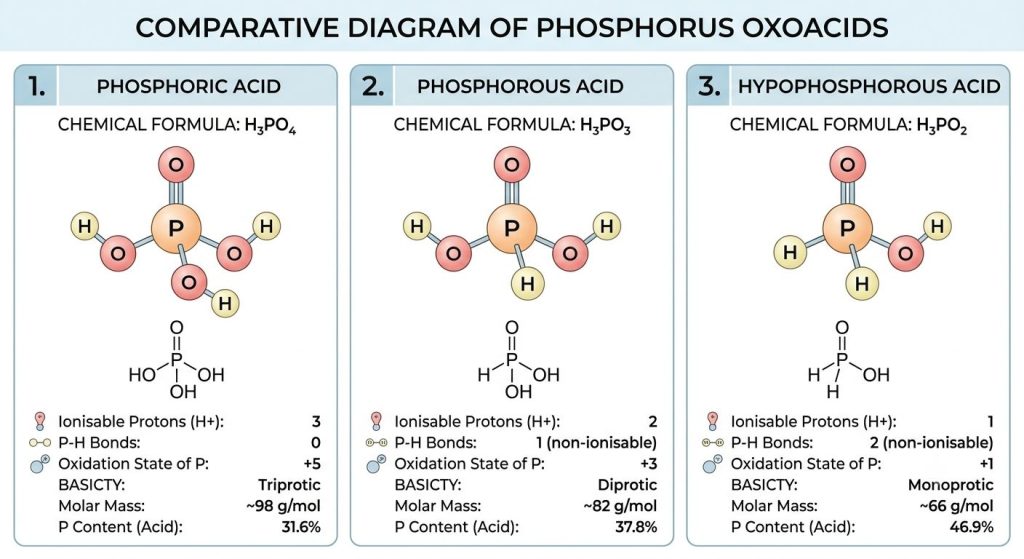
Phosphate is the fully oxidised end point. Phosphorus has no further electrons to give, which is why phosphates are stable, and inert as reductants. Phosphite retains one P–H bond and a moderate reducing capacity. Hypophosphite retains two P–H bonds and is the strongest reductant of the three by a wide margin.
The practical consequences of moving down this series (from Phosphate to Phosphite to Hypophosphite) are:
- Reducing power increases. The standard potential of the H₃PO₃/H₃PO₂ couple is approximately −0.50 V, against roughly −0.28 V for H₃PO₄/H₃PO₃. Hypophosphite will reduce nickel, copper, silver, gold and platinum-group ions out of aqueous solution; phosphate will not.
- Phosphorus density increases. Because no oxygen is carried on the two P–H positions, hypophosphites deliver substantially more phosphorus per unit mass. Aluminium hypophosphite contains roughly 42 per cent phosphorus, which is why it outperforms phosphate-based flame retardants.
- Salt chemistry simplifies. Only one salt series exists, so there are no mono-, di- and tri-basic variants to specify.
- Thermal behaviour changes. Heated dry, hypophosphites disproportionate rather than simply dehydrating, releasing phosphine and leaving phosphate residue: 2 NaH₂PO₂ → Na₂HPO₄ + PH₃, with onset temperature depending on the metal cation.
The Property That Makes Them Usable: Kinetic Stability
A strong reducing agent that reacted indiscriminately would be difficult to handle and useless as a process chemical. Hypophosphite is thermodynamically powerful but kinetically slow. Aqueous solutions are stable in air at ambient temperature for extended periods; oxidation to phosphite requires elevated temperature or a catalytic surface to activate the P–H bond.
This gap between thermodynamics and kinetics is what makes the chemistry commercially useful. An electroless nickel bath containing both nickel ions and hypophosphite does not precipitate nickel powder throughout the tank. Deposition occurs only where a catalytic surface — nickel, palladium or an activated substrate — is present to promote the reaction. The process is autocatalytic and therefore self-sustaining once started, and selective in where it plates. The same principle allows hypophosphorous acid to be dosed into a polymerisation as an oxygen scavenger without attacking the polymer.
A second consequence is that reaction conditions, not the material alone, determine behaviour. pH, temperature, catalyst and concentration all govern the rate. A hypophosphite specification is therefore incomplete without the process conditions it will meet.
Commonly used hypophosphite derivates
Product | Formula | Physical Form | CAS | Solubility in water | Thermal onset |
Hypophosphorous acid (30 / 50 / 80 %) | H₃PO₂ | Liquid | 6303-21-5 | Supplied as aqueous solution | Decomposes near 130 °C |
Sodium hypophosphite monohydrate | NaH₂PO₂·H₂O | Solid | 10039-56-2 | approx. 100 g / 100 mL | approx. 200 °C |
Calcium hypophosphite | Ca(H₂PO₂)₂ | Solid | 7789-79-9 | approx. 15 g / 100 mL | approx. 320 °C |
Magnesium hypophosphite hexahydrate | Mg(H₂PO₂)₂·6H₂O | Solid | 10377-57-8 | Freely soluble | approx. 300 °C |
Aluminium hypophosphite | Al(H₂PO₂)₃ | Solid | 7784-22-7 | Effectively insoluble | approx. 300 °C |
Potassium hypophosphite | KH₂PO₂ | Solid | 7782-87-8 | Very soluble, deliquescent | approx. 200 °C |
Ammonium hypophosphite | NH₄H₂PO₂ | Solid | 7803-65-8 | Very soluble | approx. 170 °C |
Nickel hypophosphite hexahydrate | Ni(H₂PO₂)₂·6H₂O | Solid | 13477-97-9 | Soluble | approx. 200 °C |
Solubility decides whether a salt is used in solution chemistry or as a solid-phase additive. Thermal onset decides which polymer processes survive. Between them, these two properties account for most product selection, and they are the reason one hypophosphite is not a substitute for another.
Principal Applications by Product
Hypophosphorous Acid (H₃PO₂)
Hypophosphorous acid has two fundamental functions in industrial chemistry. It is a strong reducing agent, and it is the precursor from which other hypophosphite/phosphinate derivatives are produced. Its commercial utility is consequently derived both from the reducing chemistry of the two P–H bonds in the HP(O)(OH)H structure and from its role as the parent acid of the hypophosphite family.
A major established application is colour stabilization in polymers, resins and synthetic fibres. Darkening or colour development in these systems arises from three sources — thermo-oxidative degradation of the chain during high-temperature processing, oxidation of unsaturated fatty acid residues, and transition metal ions, principally iron, which both catalyse oxidation and form coloured complexes. Hypophosphorous acid addresses all three. It scavenges dissolved oxygen, reduces Fe³⁺ to the less catalytically active Fe²⁺, and chemically reduces the carbonyl and quinoid chromophores already formed. The acid is oxidised to phosphorous acid in the process, so the reduction is sacrificial and the polymer is protected.
For this reason, hypophosphorous acid is normally incorporated during the early stages of esterification or polymerisation, rather than being used as a post-process colour correction agent. In alkyd and unsaturated polyester manufacture the dosage is 0.2-0.5% (w/w), and is generally established against the required final colour specification, commonly measured by APHA or Gardner colour. The same function is applied across polyamide and nylon fibre, polyester fibre, polyacrylonitrile, epoxies, glycerol and fatty acid esters, where it acts additionally as an antioxidant and exerts catalytic activity in polycondensation..
In organic synthesis the reagent operates through the same P–H chemistry. It reduces arenediazonium salts to the parent arene by a radical chain in which the hypophosphite donates a hydrogen atom to the aryl radical, which is the standard route for using an amino group as a directing group and then removing it. Under radical initiation the P–H bond adds across an alkene to give alkyl-H-phosphinic acids, the entry point to phosphinate pharmaceutical and agrochemical intermediates, including veterinary products such as butaphosphan. The same reducing capacity precipitates gold, silver and platinum-group metals from solution in the elemental state, which highlights its use in refining and recovery of metals from spent process liquors. Electronics grades, specified to parts-per-billion trace metals, serve semiconductor etching and metallisation, where the reductant must not introduce the ionic contamination.
Sodium Hypophosphite (NaH₂PO₂·H₂O)
The sodium salt is used primarily in electroless nickel plating, which remains the single largest application for the class. The deposition reaction is:
Ni²⁺ + 2 H₂PO₂⁻ + 2 H₂O → Ni⁰ + 2 H₂PO₃⁻ + H₂ + 2 H⁺
Acid baths run at pH 4.4 to 5.2 and 85 to 92 °C, with sodium hypophosphite at 25 to 35 g/L. Phosphorus co-deposits with the nickel and sets the coating properties: low phosphorus (1 to 4 %) is hardest as plated at about 700 HV, while high phosphorus (10 to 13 %) is amorphous, non-magnetic and the most corrosion resistant. The same chemistry produces the nickel barrier layer in ENIG and ENEPIG finishes on printed circuit boards, where nickel hypophosphite is also used as a single-salt source of both metal and reductant.
Beyond plating, sodium hypophosphite acts as a chain transfer agent in acrylic acid polymerisation, yielding phosphino-polycarboxylate scale inhibitors for cooling water and dispersants for detergents. It catalyses formaldehyde-free durable press finishing of cotton with BTCA or citric acid at 3 to 6 per cent on weight of fabric, and serves as a polyamide polymerisation catalyst and colour stabiliser dosed at 20 to 100 ppm as phosphorus.
Calcium Hypophosphite (Ca(H₂PO₂)₂)
Calcium hypophosphite serves two distinct markets.
In veterinary medicine it is used as an injectable or oral mineral supplement, supplying bioavailable calcium and phosphorus from a single salt. It is used to treat acute hypophosphataemia, milk fever, parturient paresis, and combined calcium, phosphorus deficiency in cattle, horses, sheep and swine. Phosphorus depletion frequently accompanies hypocalcaemia at parturition, which is why combined mineral therapy is preferred to calcium alone in downer cow cases.
In polymers, calcium hypophosphite functions as a halogen-free flame retardant (HFFR) additive. At approximately 36 per cent phosphorus, it acts in both the gas phase, releasing radicals that interrupt combustion, and the condensed phase, where the residue promotes char formation. UL94 V-0 at 1.6 mm has been demonstrated in polyamides, PLA, TPE, TPU, polycarbonate and ABS at loadings of 5 – 30 wt %, depending on matrix and synergist. Against aluminium hypophosphite the trade-off is efficiency for thermal margin. Aluminium hypophosphite carries more phosphorus and so reaches a given rating at lower loading, but decomposes near 300 °C. Calcium hypophosphite is stable to approximately 320 °C, which makes it the choice for polymers processed at high melt temperature or with long residence time, where the aluminium salt would evolve phosphine and leave voids in the moulding.
Aluminium Hypophosphite (Al(H₂PO₂)₃)
At approximately 42% (w/w) phosphorus and effectively insoluble in water, aluminium hypophosphite offers high phosphorus efficiency among halogen-free flame retardants in this family. Its low water solubility also limits migration during humid ageing and hot-water immersion. It is commonly used in engineering plastics such as Polyamides, Polyesters, Polyurethanes, Epoxies, HDPE, PP, PE etc. Typical loadings are 15 to 25 wt % in glass-filled PBT and PA66 for UL94 V-0 at 1.6 mm, and 20 to 25 wt % in epoxy casting systems and electrical laminates. It is commonly combined with a nitrogen synergist such as melamine polyphosphate or melamine cyanurate.
Surface-modified grades are produced specifically to raise the decomposition onset and improve dispersion in the matrix. It is further being adopted as a replacement of antimony trioxide in brominated formulations, contributing phosphorus-based activity of its own while improving flame retardancy and reducing smoke. Particle size matters: a D50 at or below 10 µm disperses better and imposes a smaller penalty on impact strength than a coarse grade at equal loading.
Magnesium Hypophosphite (Mg(H₂PO₂)₂·6H₂O)
Magnesium Hypophosphite salt supplies bioavailable magnesium and phosphorus in veterinary formulations. It is commonly used with a calcium salt such as calcium borogluconate to address hypomagnesaemia, including grass tetany, as well as the phosphorus depletion that accompanies parturient paresis. Demand is also driven by nutritional supplementation in humans and livestock where a bioavailable source of both minerals is required.
Outside animal health, magnesium hypophosphite is used as a reducing agent in organic and inorganic synthesis, as an intermediate in metal compound manufacture, and in the surface treatment of magnesium alloys.
Handling, Storage and Regulatory Notes
Hypophosphites are non-toxic or have low acute toxicity and are handled routinely, subject to three requirements. They must never be stored or mixed with strong oxidisers — nitrates, chlorates, perchlorates or nitric acid — as dry mixtures are potentially explosive. Dry material usually must not be heated above approximately 150°C, at which point phosphine is evolved. Sodium and magnesium hypophosphite are hygroscopic, and should be stored at room temperature (~30 °C) in sealed HDPE-lined bags.
Buyers importing into the United States should confirm that their supplier or importer of record holds a current DEA registration. Hypophosphorous acid and its salts are List I chemicals, with no threshold quantity, so every transaction is a regulated transaction and end-use documentation forms part of every order.
Aqueous hypophosphorous acid is consigned as UN 3264, Corrosive liquid, acidic, inorganic, n.o.s., Class 8, Packing Group II. Classification of the solid salts varies by grade and should be taken from the supplier’s safety data sheet rather than a generic entry, particularly where consignments move LCL to ports operating hazardous goods restrictions.
Sourcing Hypophosphites from NEEMCCO
NEEMCCO has manufactured hypophosphites in Mumbai since 1969 and is Asia’s first producer of this chemistry at scale. Because our product range is built on our own hypophosphorous acid we have complete control over the purity of the downstream products.
Product information: Hypophosphorous Acid | Sodium Hypophosphite | Calcium Hypophosphite | Magnesium Hypophosphite | Aluminum Hypophosphite
Technical data sheets, samples and formulation support are available on request at office@neemcco.com
Frequently Asked Questions
Q1. Why are hypophosphites stronger reducing agents than phosphites or phosphates?
Answer: Hypophosphites are strong reducing agents because phosphorus is in the +1 oxidation state and the molecule contains two P–H bonds, allowing phosphorus to undergo substantial oxidation toward the thermodynamically stable +5 state. Phosphites, with phosphorus in the +3 oxidation state and typically one P–H bond, have less reducing capacity. Phosphates contain phosphorus in its fully oxidised +5 state and therefore cannot act as reducing agents under normal conditions.
Q2. Can one hypophosphite be substituted for another?
Answer: Not always. Although the hypophosphite anion is the same, different salts can vary significantly in solubility, reactivity, and thermal stability. For example, sodium hypophosphite is highly water-soluble and reactive, while aluminium hypophosphite is essentially insoluble and thermally stable. These differences determine whether a salt is suitable for applications such as plating or polymer compounding.
Q3. Why is aluminium hypophosphite preferred for flame retardancy?
Answer: Aluminium hypophosphite has a high phosphorus content of approximately 42%, enabling effective flame retardancy at relatively low loading levels. Its low water solubility provides good resistance to leaching during humid ageing and water immersion. During combustion, it promotes the formation of phosphorus-rich protective char and flame-inhibiting species, reducing heat release and slowing further degradation of the polymer.
Q4. What should be specified when purchasing?
Answer: Assay, impurity profile, sulphate, iron and heavy metals content. For flame-retardant grades add particle size distribution, moisture and surface treatment status; for pharmaceutical and veterinary use, confirm GMP status.