Why Two Electroless Nickel Baths With the Same Hypophosphite Concentration Can Perform Differently

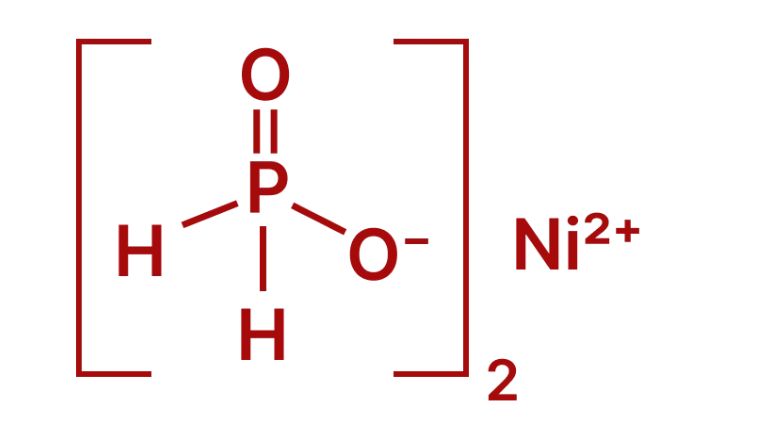
Two electroless nickel baths with identical hypophosphite concentrations can plate very differently because concentration is only one variable. Bath age, orthophosphite buildup, pH, temperature, complexing agents, stabilizer balance and contamination all shape plating rate and deposit quality. A fresh, well-controlled bath and an aged one can show the same titration result and still behave nothing alike.
Picture a plating shop running two tanks side by side. Both were titrated this morning, and both show the same sodium hypophosphite level. Yet one plates smoothly at a steady rate, while the other is sluggish and leaves rough patches on the parts. Same number on the lab sheet, very different results on the floor.
Why hypophosphite concentration alone doesn't tell the full story
Hypophosphite is the reducing agent. It supplies the electrons that turn nickel ions into a nickel-phosphorus deposit, so it absolutely matters. But a titration only tells you how much is left in the tank. It says nothing about what has built up around it.
An electroless nickel bath is a balanced system. Nickel, reducer, complexing agents, stabilizers, pH and temperature all pull on each other. Change one, and the others respond.
The hidden factor: orthophosphite buildup and bath age
Every time hypophosphite does its job, it converts to orthophosphite. That byproduct stays in the bath and keeps climbing as the bath ages, which is usually tracked in metal turnovers (MTOs).
As orthophosphite rises, the plating rate typically slows and the bath becomes less tolerant of pH swings. The risk of nickel phosphite precipitating also goes up. That is when shops see rough deposits, pitting or sudden bath breakdown. A young bath and an old one can hold the same hypophosphite level while carrying very different orthophosphite loads.
pH, temperature, and complexing agents: a balancing act
Plating rate rises with pH and temperature, but so does the pull toward instability. Phosphorus content in the deposit also shifts with pH, which in turn affects hardness, corrosion resistance and magnetic behavior.
Complexing agents add another layer. They hold nickel in solution and buffer the pH, and each chemistry handles orthophosphite and aging differently. Two baths built on different formulations simply won’t behave alike at the same hypophosphite level. Stabilizers follow the same logic: too little invites spontaneous decomposition, and too much poisons the plating reaction.
Does contamination and raw-material purity matter?
Yes. Metal ions such as copper, zinc or lead, along with chloride and sulphate, can interfere with plating or shorten bath life. Some arrive through rinse water, rack stripping or dragged-in solutions. Others ride in with the chemicals you add.
That’s why the quality of your reducing agent matters. Neemcco’s sodium hypophosphite monohydrate (CAS 10039-56-2) is supplied at >99% purity, with heavy metals below 20 ppm, calcium below 30 ppm, and chloride and sulphate each below 50 ppm. Cleaner inputs don’t guarantee a perfect bath, but they remove one source of variability and make troubleshooting far easier.
Loading and agitation: the small stuff that adds up
Even with identical chemistry, a heavily loaded tank consumes nickel and hypophosphite faster than a lightly loaded one. Poor agitation or uneven heating creates local differences in temperature and concentration. Two tanks that look the same on paper can be working under very different conditions.
How to diagnose two baths that behave differently
Start by comparing more than hypophosphite. Check bath age and MTO count, orthophosphite level, pH at operating temperature, temperature uniformity, stabilizer additions, loading and agitation. The table below shows how a fresh, well-controlled bath can differ from an aged or neglected one.
Factor | Fresh, well-controlled bath | Aged or poorly controlled bath | Effect on plating |
Orthophosphite level | Low | High | Slower rate, higher precipitation risk |
pH control | Stable, tight window | Drifts, harder to buffer | Rate swings, variable phosphorus content |
Stabilizer balance | Calibrated additions | Over- or under-dosed | Skip plating or spontaneous decomposition |
Contamination | Clean water, filtered solution | Metal ions, particulates | Pitting, roughness, dull deposits |
Plating rate | Steady and predictable | Slow or erratic | Inconsistent thickness |
Deposit quality | Smooth and uniform | Rough, stressed or patchy | More rejects and rework |
If your two baths differ on even two or three of these rows, you’ve likely found your answer.
Keeping baths consistent
Consistency comes from tracking the whole bath, not just the reducer. Log your MTOs, test orthophosphite regularly, replenish by analysis rather than habit, and buy your hypophosphite from a supplier who documents every batch.
Neemcco has been manufacturing hypophosphites since 1969 and is ISO 9001:2015 and GMP certified. Every batch ships with a COA and SDS, so you can verify specifications before you order. Explore our sodium hypophosphite, nickel hypophosphite or hypophosphorous acid, browse the full product range, or contact our team for specifications and technical support.
Frequently Asked Questions
Q1. Does hypophosphite concentration control the plating rate in electroless nickel?
Answer: Partly. It is one of several factors, alongside pH, temperature, nickel level, complexing agents and orthophosphite buildup. Two baths with the same hypophosphite level can still plate at different speeds.
Q2. What are the signs of orthophosphite buildup in an electroless nickel bath?
Answer: Common signs include a slowing plating rate, a bath that is harder to keep within its pH window, and rougher or pitted deposits. In severe cases, nickel phosphite can precipitate and the bath may need to be replaced.
Q3. Does bath age matter if I keep replenishing the chemicals?
Answer: Yes. Replenishment restores nickel and hypophosphite, but orthophosphite and other byproducts keep accumulating. Tracking metal turnovers helps you decide when a bath is nearing the end of its useful life.
Q4. How does raw-material purity affect electroless nickel bath stability?
Answer: Impurities such as heavy metals, chloride or sulphate in the reducing agent can add to contamination already entering the bath. Using a consistent, high-purity grade reduces one source of variability, though it doesn’t replace good bath control.
Q5. How do I choose a sodium hypophosphite supplier for electroless nickel plating?
Answer: Look for documented purity and impurity limits, batch-wise COA and SDS, consistent quality across shipments, and quality certifications such as ISO 9001. A supplier who can answer technical questions is a real advantage when you’re troubleshooting.