Sodium Hypophosphite in Electroless Nickel Plating: Process Chemistry Explained

Electroless nickel plating looks simple from the outside. Parts go into a hot bath and come out with an even, protective coat. Inside the tank, though, a lot of chemistry is at work, and most of it comes down to one ingredient.
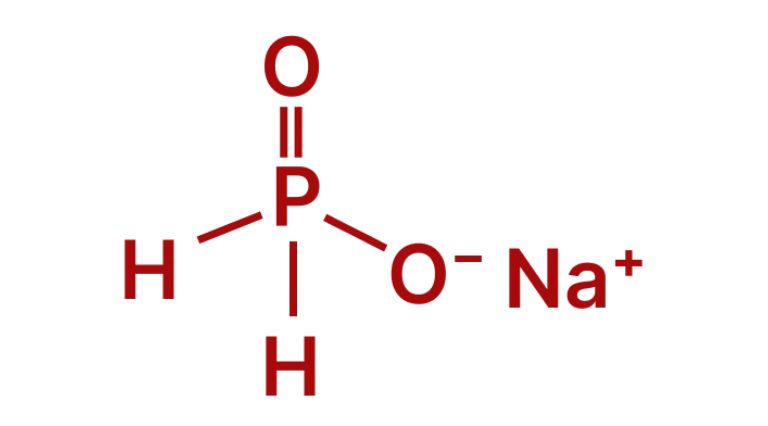
Sodium hypophosphite is the reducing agent that turns dissolved nickel into a metal coating, with no electric current needed. If you run a plating line or buy chemicals for one, knowing how it behaves helps you control thickness, phosphorus content and bath life.
This guide walks through the process chemistry in plain language.
Why Electroless Nickel Needs a Reducing Agent
Electroplating pushes nickel onto a part using current. Electroless plating does the same job with a chemical reaction.
The bath holds nickel ions (Ni²⁺). They need electrons to become solid nickel. Sodium hypophosphite (NaH₂PO₂) supplies those electrons.
The process is also autocatalytic. Once the first thin layer of nickel forms, it catalyses further deposition. The coating keeps growing on its own, evenly, even inside holes and recesses.
The Core Reaction, Step by Step
At the surface of the part, hypophosphite gives up electrons and becomes phosphite. Nickel ions pick those electrons up and settle as metal.
The simplified overall reaction looks like this:
Ni²⁺ + 2H₂PO₂⁻ + 2H₂O → Ni + 2H₂PO₃⁻ + H₂ + 2H⁺
Three things happen at once:
- Nickel ions are reduced to metallic nickel
- Hypophosphite is oxidised to phosphite
- Hydrogen gas is released and the bath turns more acidic
A small share of the hypophosphite is also reduced to elemental phosphorus. That phosphorus co-deposits with the nickel, which is why the coating is called nickel-phosphorus (Ni-P).
In practice, a good portion of the hypophosphite is lost to side reactions. This is why the bath needs steady replenishment.
What Else Goes Into the Bath
Sodium hypophosphite never works alone. A typical bath balances:
- Nickel source: usually nickel sulphate
- Reducing agent: sodium hypophosphite, often around 20–40 g/L
- Complexing agents: organic acids that keep nickel in solution and buffer the pH
- Stabilisers: trace additives that stop the bath from decomposing on its own
- pH adjusters: because the reaction keeps releasing acid
Acid baths are the most common. They usually run at pH 4.4–5.2 and about 85–95 °C. Alkaline baths work at a higher pH and lower temperature.
Controlling Phosphorus Content
Phosphorus content decides how the coating behaves. Bath pH, temperature and hypophosphite level all push it up or down. A lower pH generally gives a higher phosphorus deposit.
Type | Phosphorus | What it is usually chosen for |
Low phosphorus | 1–5% | Wear resistance, solderability |
Mid phosphorus | 6–9% | General engineering parts, balanced performance |
High phosphorus | 10–13% | Corrosion resistance, non-magnetic parts |
Pick the class by what the part has to survive, then set the bath to match.
Replenishing Without Upsetting the Balance
Top up nickel and hypophosphite together, in small and frequent additions. One large dose can shock the bath and set off spontaneous decomposition. You will see it as fine black particles and plating on the tank walls.
A few habits help:
- Analyse nickel and hypophosphite levels on a fixed schedule
- Add replenishers slowly, with good agitation
- Watch the pH, since it drifts down as the reaction runs
- Filter the bath to remove stray particles
Orthophosphite Build-Up: The Quiet Bath Killer
Every nickel atom deposited leaves phosphite behind. It does not leave the tank.
As it accumulates:
- The plating rate slows down
- Deposits become more stressed and less uniform
- Nickel phosphite can precipitate and cloud the solution
Shops track this through metal turnovers (MTOs). One MTO means the nickel in the bath has been replaced once. Many baths are retired somewhere around 5–10 MTOs, depending on the chemistry.
Because the solution is reused across several turnovers, small impurities in your raw materials add to that load.
Why Hypophosphite Quality Matters in the Tank
Trace contaminants compound over time. Heavy metals can upset bath stability and cause rough plating or plate-out on tank walls. Calcium can form insoluble salts, while extra sulphate and chloride shift the solution balance.
That is why Neemcco supplies sodium hypophosphite (CAS 10039-56-2) against a defined specification:
- Assay: above 98%
- Heavy metals: below 20 ppm
- Calcium: below 30 ppm
- Sulphate: below 50 ppm
- Chloride: below 50 ppm
It is a white crystalline powder and dissolves readily in water, which makes make-up and replenishment solutions easy to prepare. It is also hygroscopic, so keep bags sealed and dry between uses.
Sourcing Sodium Hypophosphite for Your Plating Line
Looking for a sodium hypophosphite supplier in India for a new bath or a top-up? Share your grade requirement, monthly volume, and delivery destination with the Neemcco team.
Material ships in 25 kg HDPE bags, with a batch-wise COA and SDS available on request. Ask for them before your first order so your lab can check the numbers against your own bath specification.
Frequently Asked Questions
Q1. How is electroless nickel plating different from electroplating?
Answer: Electroplating needs an external current, so thickness varies with part shape and edges get more coating. Electroless plating uses a chemical reaction, so the layer stays even across corners, holes and recesses.
Q2. Are there alternatives to sodium hypophosphite as a reducing agent?
Answer: Yes. Sodium borohydride, dimethylamine borane (DMAB) and hydrazine are used for specialised deposits such as nickel-boron. Sodium hypophosphite remains the most common choice because it is economical and gives stable, well-understood baths.
Q3. How thick can an electroless nickel coating be, and how fast does it plate?
Answer: Most engineering coatings fall between 5 and 25 microns. Acid baths typically deposit around 10–25 microns per hour, and thicker layers are possible with longer immersion.
Q4. How hard is electroless nickel plating?
Answer: As-plated hardness is roughly 500–700 HV. Heat treatment at around 400 °C for about an hour can raise it to roughly 900–1,000 HV.
Q5. Can you electroless nickel plate aluminium or plastic?
Answer: Yes, with the right preparation. Aluminium needs a pretreatment such as zincating. Plastics need etching and a catalytic activation step because they cannot start the reaction on their own.
Q6. What are the disadvantages of electroless nickel plating?
Answer: It costs more and runs slower than basic electroplating on simple parts. The bath needs tight control and has a limited life, and spent solution must be treated before disposal.
Q7. Is sodium hypophosphite hazardous to handle and store?
Answer: It is not highly toxic, but treat it with care. Strong heating can release phosphine gas, and mixing it with strong oxidisers such as nitrates or chlorates can be dangerous. Store it cool, dry and away from oxidisers, and follow the SDS.
Q8. Is electroless nickel plating RoHS compliant?
Answer: It can be, but it depends on the bath. Some stabilisers contain lead or cadmium, so ask your chemical supplier for a declaration that the system is free of restricted substances.